Overview
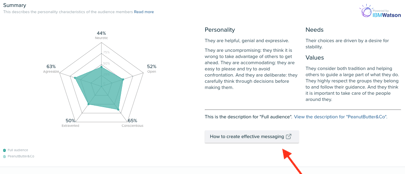
The Personality Insights tab analyzes the language used by members of your audience to estimate shared personality characteristics and motivations.
These insights can help you:
- Develop messaging that resonates with your audience.
- Refine your brand's tone of voice.
- Compare personality traits across audience segments.
- Understand how different audiences may respond to campaigns or content.
Rather than identifying individual personalities, Personality Insights provides an aggregated view of the audience as a whole.
How Personality Insights Works
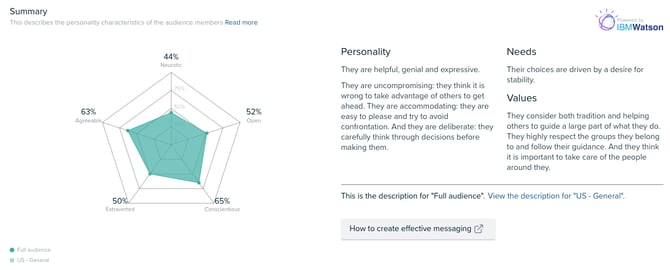
Personality Insights analyzes original content written by members of your audience. To improve the quality of the analysis, reposted content is excluded, allowing the model to focus on language created by each individual. This language is then analyzed to estimate personality traits, psychological needs, and personal values across the audience. The resulting scores represent the average intensity of each characteristic within the audience rather than the percentage of users who possess that trait. For example, if an audience receives a score of 44 for Neuroticism, it means the audience's average intensity for that characteristic is 44 out of 100. It does not mean that 44% of the audience is neurotic.
Personality Models
Personality Insights is organized into three complementary models that describe different aspects of your audience.
Big Five (OCEAN)
The Big Five, also known as OCEAN, measures five broad personality dimensions:
| Personality Trait | Description |
|---|---|
| Openness | Willingness to explore new ideas and experiences. |
| Conscientiousness | Preference for organization, planning, and responsibility. |
| Extraversion | Tendency to seek social interaction and external stimulation. |
| Agreeableness | Inclination toward cooperation, empathy, and compassion. |
| Neuroticism | Tendency to experience emotional sensitivity and stress. |
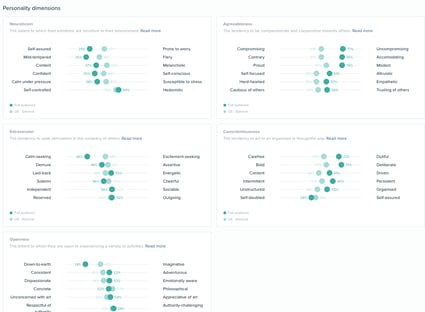
Each dimension can be expanded to reveal six additional personality facets that provide more detailed insights into audience behavior.
Needs
The Needs model identifies the types of experiences, products, or messaging that are most likely to resonate with your audience. These characteristics help explain what motivates engagement and what audiences may value when interacting with brands, products, or services.
Values
The Values model identifies the principles that are most likely to influence your audience's decision making.
Examples include:
- Self-transcendence
- Conservation
- Hedonism
- Self-enhancement
- Openness to Change
Together, these models provide a broader understanding of what motivates your audience beyond demographics or interests.
Compare Against a Baseline
Personality scores are most valuable when viewed relative to a comparison audience.
Common comparisons include:
- An audience segment compared to the full audience.
- The full audience compared to a country or global baseline.
- One audience segment compared with another.
- The same audience compared across reports created at different points in time.
Using a baseline helps identify which personality traits are most distinctive for the selected audience.
Interpreting Personality Scores
Each personality score ranges from 0 to 100. Scores near 50 indicate an average level for that characteristic. Scores farther from 50 represent stronger tendencies toward one end of the personality spectrum. For example, a score of 80 indicates a much stronger tendency than a score of 55. When comparing audiences, focus on the traits that differ most from the selected baseline rather than looking only at the highest numeric values.
Personality Facets
Selecting one of the Big Five personality dimensions displays six additional personality facets that provide more detailed insight into that characteristic. Hover over a facet to view its description and better understand what it represents. The facets are automatically ordered based on how much they differ from the selected baseline, making it easier to identify the characteristics that most distinguish your audience.
Effective Messaging Recommendations
The Personality Insights tab includes recommendations that help translate personality analysis into messaging strategies.
These recommendations can help guide:
- Tone of voice
- Messaging style
- Creative direction
- Brand positioning
- Visual communication
You can also download the Effective Messaging guide for additional guidance on communicating with audiences that exhibit different personality characteristics.