
Overview
Follow this article to learn about the Socioeconomics tab in Audiense Insights.
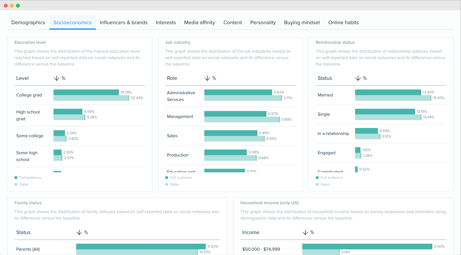
The Socioeconomics tab provides additional context about your audience by surfacing information related to education, employment, household composition, and other socioeconomic characteristics. Unlike many other insights available throughout Audiense Insights, the information displayed in this tab is derived from Meta data.
These insights help you better understand who your audience is and can support more informed marketing, messaging, and audience targeting decisions.
What Information Does the Socioeconomics Tab Include?
The Socioeconomics tab provides several categories of audience information, including:
- Education level
- Job industry
- Relationship status
- Family status
- Household income (United States only)
For audiences located in the United States, additional insights such as Household Income and Politics may also be available. Each visualization can be compared against your selected baseline, making it easier to understand how your audience differs from the comparison audience throughout your report.
Where Does the Data Come From?
Unlike many of the other tabs in Audiense Insights, the data displayed in the Socioeconomics tab is sourced from Meta. This information is presented in an aggregated and anonymized format and is intended to provide high-level audience characteristics rather than information about individual people. Because the data originates from Meta, availability may vary depending on the audience being analyzed.
Understanding Job Industry Categories
The Job Industry visualization groups audience members into broad occupational categories based on available data. These categories help identify the industries most commonly represented within your audience and can be useful when developing marketing strategies, audience personas, or business insights.
The available job industry categories include:
| Job Industry | Example Roles |
|---|---|
| Administrative Services | Secretary, administrative assistant, office manager, personal assistant |
| Architecture and Engineering | Software engineer, technician, electrician, machinist |
| Arts, Entertainment, Sports and Media | Photographer, artist, actor, singer |
| Business and Finance | Accountant, auditor, financial advisor, sales manager |
| Cleaning and Maintenance Services | Caretaker, housekeeper, gardener |
| Community and Social Services | Social worker, counselor, minister, politician |
| Computation and Mathematics | Computer scientist, analyst, mathematician |
| Construction and Extraction | Mechanic, bricklayer, machine operator |
| Education and Libraries | Teacher, professor, librarian, tutor |
| Farming, Fishing and Forestry | Farmer, crew member |
| Food and Restaurants | Chef, server, barista, cashier |
| Government Employees | Government roles |
| Healthcare and Medical Services | Physician, dentist, cardiologist |
| IT and Technical Services | IT technician, web developer, IT consultant |
| Installation and Repair Services | Technician, operator, welder |
| Legal Services | Lawyer, paralegal, corporate counsel |
| Life, Physical and Social Sciences | Chemist, psychologist, geologist |
| Management | Manager, director, supervisor |
| Production | Miner, blacksmith, lumberjack |
| Protective Services | Police officer, firefighter, security guard |
| Sales | Retail manager, consultant, customer service representative |
| Transportation and Moving | Driver, pilot, flight attendant, sea captain |
These categories provide a high-level view of the industries represented within your audience rather than detailed job titles.
Using Socioeconomic Insights
Socioeconomic insights provide valuable context that can help you better understand your audience beyond traditional demographic information. For example, understanding your audience's education levels, industries, or household characteristics can help you:
- Build more accurate audience personas.
- Refine campaign messaging.
- Better align content with your audience.
- Improve audience targeting strategies.
- Support market research and planning.
Important Notes
Because the Socioeconomics tab uses data provided by Meta, it is important to keep the following considerations in mind:
- The information displayed is aggregated and anonymized and is not associated with private information about any individual person.
- Household Income is currently available only for United States audiences.
- Household Income percentages may not total 100%, as some audience members may not have income information available or may fall outside the available income ranges (for example, households earning less than $40,000).