
Overview
Follow this article to learn how the Interest Categories feature works and how it can help provide a broader understanding of your audience’s macro interests
Interest Categories are designed to surface general themes of the things your audience cares about. This broader approach complements the Influencers & Brands tab results which more specifically identified named entities for Brand, Influencer, and Media affinities.
What Are Interest Categories?
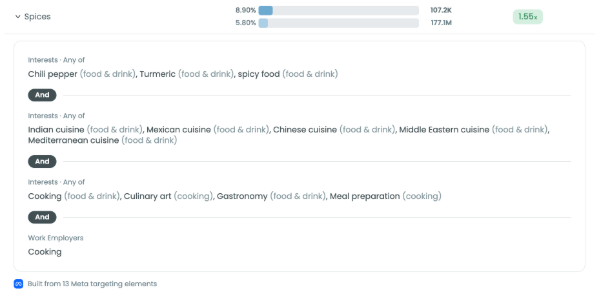
Interest Categories are the subjects that your audience cares about, as curated by our team using a roll-up approach that combines various underlying Meta interest elements. By using a layered approach to represent these broad interests, we can ensure high confidence in the applicability of the overall theme (versus only signalling when an audience has a loose connection to an underlying sub-element).
For example, seeing an Interest Category like "Snacks” means that we not only detected that an audience was tagged with being interested in “Snack food (food & drink)” or “Snacking (food & drink)” but that it ALSO exhibited at least one of these other related elements: Dried fruit (cooking), Fruit (food & drink), Mixed nuts, Nut (fruit), Potato chip (food & drink), or Snack mix (food & drink).
Why Interest Categories Matter
Interest Categories provide a fast and intuitive way to interpret high-level audience interests with confidence. Instead of analyzing isolated interest elements individually, you will better understand the overall relevance of groups of related items to their audience.
How Interest Categories Can Be Used
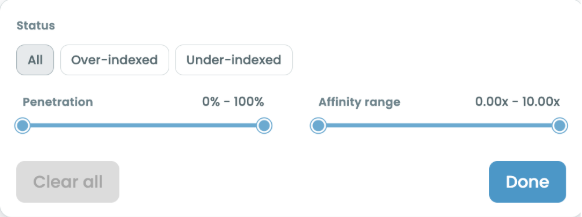
Interest Categories can help organizations better understand the overall themes their audience cares about from various perspectives. Using the available filters, you can quickly sort the results by Penetration (the applicable reach) and/or by Affinity (the index relative to baseline).
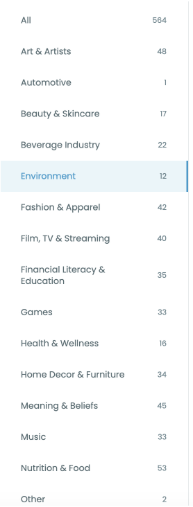
As well, the >500 Interest Categories are themselves organized into a broader taxonomy of >20 sections that can be easily navigated. Counts for each section are provided in the left-hand navigation representing the number of applicable Interest Category results that exist in the taxonomy. Only those results that apply to a given audience will appear in a report.
_________________________